August 8: A Watershed Date for Armenian Authority Between Peace and War. For three months now, at every convenient opportunity, Prime Minister Nikol Pashinyan has been saying that peace with Azerbaijan has been established, there are no shootings, people are not dying, decades-old blocked roads will be opened, trade will take place, hostility will be overcome, and we will move forward. But along which route?
TRIPP (Trump Route for International Peace and Prosperity) — says US President Trump, proudly noting that the main route connecting Azerbaijan to Nakhchivan will bear his name.
“Crossroads of Peace” — says Pashinyan, assuring that the opening of routes under the sovereignty and jurisdiction of Armenia will benefit all countries in the region and beyond.
“Zangezur Corridor” — says Aliyev, emphasizing the “unimpeded” passage of Azerbaijanis.
What is hidden behind this wordplay, and what rules are the other players in the region following?
WordPlayPeace
“The Zangezur Corridor” and the “North–South” transport corridor are not competitors,” TASS news agency, controlled by the Kremlin, wrote recently, quoting Sergey Shoigu, Secretary of the Russian Security Council.
The assessments made by the official who served for many years as Russia’s Minister of Defense during a press briefing quickly spread to both Azerbaijani and Armenian media. Soon after, TASS changed the wording in both the headline and the text, replacing “Zangezur Corridor” with “Meghri Corridor,” but in media outlets that republished the article verbatim or in translation, the original version remained.
What did Shoigu actually say? An examination of the video of the press briefing shows that the expression “Zangezur Corridor” was spoken not by Shoigu, but by the journalist from Russia24 (a nationwide federal information channel) who posed the question. In his response, the Russian Security Council Secretary used only the term “corridor,” without mentioning any place name.
“I think both routes not only have a right to exist, but are also necessary so that Azerbaijan is connected to its regions, and commercial transport corridors arise between the countries,” he said.
It turns out that Shoigu was attributed a wording he did not actually say, and the modification in the TASS article was likely due to this circumstance. Whose intervention, encouragement, or request prompted this is currently unknown. But one thing is clear: in Kremlin-controlled media, the topic of opening communication routes through Armenia is mainly covered using official Baku vocabulary and rhetoric.
Corridor or Route
Armenians do not like the word “corridor.” In Eduard Aghayan’s explanatory dictionary, we read:
A long passage inside a building connecting apartments on the same floor.
(Geog.) A narrow strip of land connecting to a sea and passing through another state’s territory.
Generally, any narrow passage stretching through an area (emphasis by the author).
We do not like this word because we see danger in it — danger for our country’s sovereignty and territorial integrity.
And what is written in the Washington document signed this year on August 8?
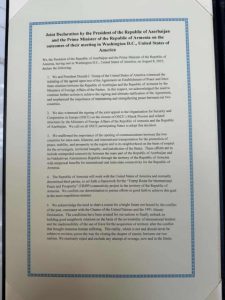
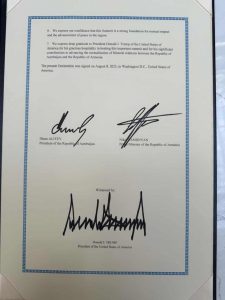
Тhe joint declaration signed by the Prime Minister of Armenia and the President of Azerbaijan, with President Trump’s signature as a witness.
Below is an excerpt from the declaration where the opening of routes is addressed:
“3. We reaffirm the importance of opening communications between the two countries for domestic, bilateral, and international transport, based on respect for the sovereignty, territorial integrity, and jurisdiction of the states, in order to promote peace, stability, and prosperity in the region and its surroundings. These efforts will include unimpeded communications through the territory of the Republic of Armenia between the main part of the Republic of Azerbaijan and the Nakhchivan Autonomous Republic of Azerbaijan, with mutual benefits for the Republic of Armenia regarding international and domestic communications.
4. The Republic of Armenia will work with the United States of America and, mutually agreed upon, third parties to establish the framework for implementing the “Trump Route for International Peace and Prosperity” (TRIPP) communication program within the territory of the Republic of Armenia. We reaffirm our determination to take all measures in good faith to achieve this goal as quickly as possible.” (emphasis by the author).
The word “corridor” is not mentioned here, but the expressions “unimpeded” and “with mutual benefits” are noteworthy. The word “unimpeded” can also be found in the trilateral statement ending the 44-day war, signed by the leaders of Armenia, Azerbaijan, and Russia five years ago.


In the above-mentioned trilateral statement, in point 9 it is written:
“All economic and transport connections in the region are unblocked. The Republic of Armenia guarantees the safety of transport communications between the western regions of the Republic of Azerbaijan and the Nakhchivan Autonomous Republic, ensuring the unimpeded movement of citizens, vehicles, and goods in both directions. The Russian FSB Border Service carries out control over transport communications. By agreement between the parties, the construction of new transport connections linking the Nakhchivan Autonomous Republic with the western regions of Azerbaijan will be ensured.”
The word “corridor” is not found here either; it is only mentioned in relation to the Lachin corridor, but unimpeded movement under the supervision of the Russian FSB Border Service is recorded. This is exactly why we do not like the term “corridor.”
Two Documents, One Opportunity
After the signing of the November 2020 trilateral document, much has changed. There are no longer Armenians living in Nagorno-Karabakh; in September 2023, more than 100,000 Armenians were forcibly displaced from their homeland due to Azerbaijani aggression.
This was preceded by months-long blockades of Nagorno-Karabakh under the pretext of environmental actions by Azerbaijanis, even though point 6 of the trilateral statement required Azerbaijan to ensure the safe movement of citizens, vehicles, and goods in both directions through the Lachin corridor. The 5 km-wide Lachin corridor, which was supposed to ensure the connection between Nagorno-Karabakh and Armenia, remained under the supervision of the Russian peacekeeping forces.
Two years ago, Russian peacekeepers left Nagorno-Karabakh; they had been informed in advance about the military operation initiated by Baku in September 2023 but did not intervene in any way.
Meanwhile, the presence of Russian FSB border guards in Armenia continues; they monitor the Armenian-Turkish border. In October last year, Putin and Pashinyan agreed in Moscow that from January 1, 2025, Russian border guards would withdraw from the Armenian-Iranian border checkpoint. Armenian officials do not hide that, with sufficient capacity development, the RA NSS border guards will replace Russian border guards at all sections of the state border.
The pre-signing of the Armenian-Azerbaijani Peace Treaty under the auspices of the US, along with Armenia’s aspirations to join the EU, do not fit in any way with Moscow’s plans. This is stated bluntly by the Russian Foreign Minister.
Sergey Lavrov said at a plenary session following the high-level Minsk Third International Conference on Eurasian Security:
“NATO and the European Union are building their own dialogues and cooperation frameworks with the countries of Central Asia and the South Caucasus, and the West is trying to use these connections not so much for mutually beneficial cooperation as to separate these countries from the Russian Federation. We will prevent such trends with all available means—diplomatic, political, economic.”
The countdown has begun: Armenia’s parliamentary elections are on June 7, 2026.
Vanik Hakobyan, Editor-in-Chief of Factor TV