“Ponchiks” are ready: the women in the bakery of Mets Masrik village in the Gegharkunik region know well that observers from the EU mission in Armenia, Mika and Swantje, love their ponchiks (donuts). When they see their car, they prepare ponchiks. It’s been like this for more than two years.
Mika Kouri and Swantje Meinke are monitors for the European Union Mission in Armenia (EUMA), an unarmed civilian mission deployed in February 2023. The monitors and other experts of EUMA come from 25 EU member states and Canada, bringing diverse professional backgrounds to a singular task. The European Union Mission in Armenia comprises its headquarters (HQ) in Yeghegnadzor, a liaison and support office in Yerevan, and six Forward Operating Bases (FOBs) in Ijevan, Martuni, Jermuk, Goris, Kapan, and Yeghegnadzor. The monitoring team based in Martuni is responsible for the entire Gegharkunik region.
Their job is to be the EU’s “eyes and ears” on the ground, patrolling the border with Azerbaijan to observe the security situation, report on incidents, and build confidence in communities living under the shadow of conflict.
This mission is a focal point in a complex geopolitical crucible. For Armenia, it is a tangible symbol of a strategic pivot towards the West after its decades-long security alliance with Russia failed to prevent incursions onto its territory. For Azerbaijan and Russia, it is a contested geopolitical intrusion. But on the ground, for Mika Kouri and Swantje Meinke, the mission is about human beings.
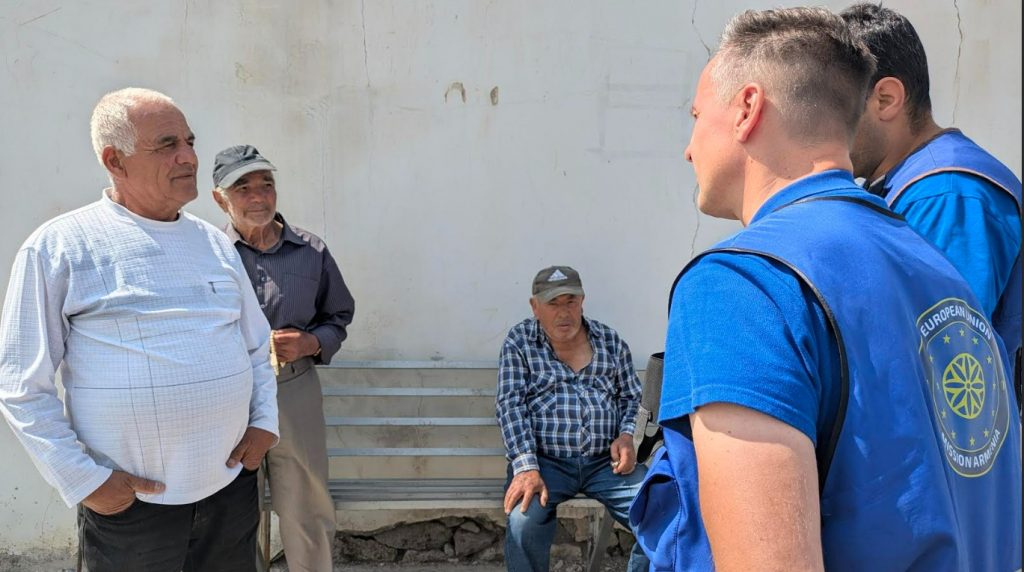
The day for the monitors, such as Mika Kouri and Swantje Meinke, typically starts with meticulous planning at their Forward Operating Bases (FOBs).
Mika, who is a team leader, gathers his team around maps to define the day’s patrol route, identify key observation points, and conduct risk assessments based on the latest intelligence. This “invisible” planning phase is crucial for ensuring the safety and effectiveness of their work.
Mika says his team plans to visit villages for human security patrols, to speak with people affected by the conflict, and to learn about the security situation and the challenges they face.
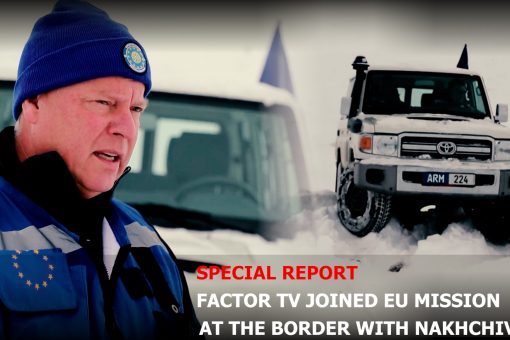
Once planning is complete, monitors deploy in their distinctive EUMA vehicles. The stops on this day are three villages in Gegharkunik province: Sotk, Kut, and Norabak.
The air is thin and clear high in the mountains of Armenia’s Gegharkunik province. In a white 4×4, Finnish Border Guard officer Mika Kouri and German Police officer Swantje Meinke navigate a winding dirt road. Below them, the vast, deep blue of Lake Sevan stretches towards the horizon. Ahead, the ridgelines mark not just a stunning landscape, but a tense and volatile international border.
“Here in Armenia, the mountains are higher”, – says Mika, a 54-year-old veteran from Lapland. The scale is even more impressive for Swantje, 32, who is from the flat plains of northern Germany. “I’m so astonished about this”, – she says. “Feeling so grateful that I have the opportunity to be here.”
We observed that locals frequently greeted them from their cars. Swantje confirms that it’s normal, as many people in the area recognize the mission members. She added that this welcoming feedback makes her feel very welcome, and sometimes these greetings lead to friendly conversations.
From Armenia’s border to Brussels: The EU mission’s role as a ‘reporting tool’
The opportunity to work in the European Union mission in Armenia was one Mika pursued with interest. Mika, the Team Leader of the Forward Operating Base in Martuni, has managed the sensitive Finnish-Russian border since 1994. He is seconded by the Crisis Management Centre Finland (CMC Finland), which serves as Finland’s centre of expertise for civilian crisis management. CMC Finland is responsible for the training and recruitment of all experts seconded to international assignments, acting as the employer for both civilian crisis management professionals and OSCE election observers. Finland deploys experts through CMC Finland to missions led by the EU, UN, OSCE, NATO, the Council of Europe, and other international organisations. Experts are engaged in a wide range of roles, including policing, judicial administration, border security, customs, enforcement of criminal sanctions, international policy, human rights, reporting, and communications. His experience in the sparsely populated north, where border guards are often the only state representatives, has prepared him for the human-centric work in Armenia’s villages.
He feels he can contribute to conflict resolution, offering his personal input as a stabilizing element. Having led a team in the Gegharkunik region for two years, he has one year remaining of his three-year tour.

“I would like to see people no longer affected by conflict”, – Mika explains. “For this kind of work in conflict areas, we need a personal interest to be part of this important work of fostering peace and being part of this stabilizing process. You can’t do this just for the job. For me, it’s important to be part of an institution that wants to be a stabilizing factor and is genuinely working towards peace between the countries. It gives me personal satisfaction.”
The observations made by monitors like Mika and Swantje are grounded in facts and neutrality. They observe all types of military changes in the area, learning very quickly if tensions increase. Their findings are then reported to Brussels, which in turn informs the EU member states.
“As the Head of Mission often says, we would like to work and patrol on both sides “, – says Mika. ” We try to be very open and transparent about our mandate. Our mission’s mandate is very transparent: we observe, monitor, discuss with people affected by the conflict, and report these findings directly to Brussels. We are an EU tool for maintaining situational awareness of what is happening in the country, especially if there is a military escalation.”
Still, they must manage local expectations. Some residents, feeling abandoned by their traditional allies, initially hoped for armed peacekeepers. “Sometimes they wish we were here to support them with weapons”, – Swantje Meinke explains. “Then we have to explain what we are actually doing… that we are a civilian mission here for stabilizing the situation.”
During the September 2022 clashes between Armenia and Azerbaijan, Russian guards stationed in the Gegharkunik region reportedly fled, an act witnessed by local residents. This prompted the question to Mika: “In a tense situation, would you stay to observe or would you leave?”
“It depends on the situation, of course”, – he responds. “If we are in immediate danger, we move away from the location, but we continue the work from a distance. It’s important that safety and security are taken care of, but when the situation occurs, we create distance and continue our work. So the shooting itself does not stop our performance, but it’s self-explanatory that we have to adjust and assess the situation to ensure circumstances are safe and secure for the team members.”
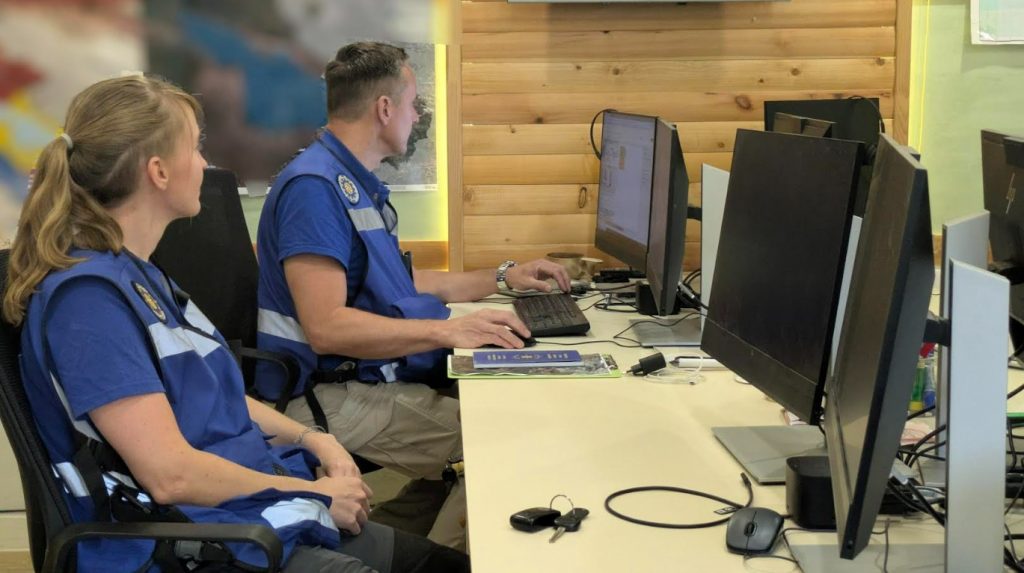
The mission faces a coordinated disinformation campaign, mainly from Azerbaijan or Russia, labeling them as spies. Mika believes the key to tackling these campaigns is transparency.
“I think that increasing Armenians’ knowledge of what the European Union Mission in Armenia is doing is the key element for tackling these disinformation campaigns”, – he says. “If Armenians know exactly and are fully aware of why we are here and what we are doing, then this disinformation won’t be effective. When disinformation really gets a foothold among the population, it means there is not enough information shared with them about what the mission is doing.”
For Mika, the most rewarding part of the work is when he sees that the mission’s presence is well-received.
“Often when we are patrolling and discussing with representatives of border communities, they emphasize that the European Union Mission’s presence brings them a greater sense of safety, and that our presence has led to a decrease in shooting incidents. That’s a very practical example of our work and its effectiveness. Those are perhaps the most rewarding moments, when we really learn that the work we have done is meaningful.”
Every day, monitors like Mika and Swantje meet with locals. They are always ready to explain what the mission is doing and the tasks they are carrying out. Mika says that their mission has been welcomed here and people are ready to share their concerns, feelings, and expectations.
“Armenians are really open and friendly”, – he shares. “You are ready to open your doors, your private space at home, asking us to come in for coffee with your families, have discussions, and share thoughts and experiences. This has been a really, unbelievably nice experience for me personally.”
Mika explains that the working mechanism of the mission is very clear. Their work is to impartially and neutrally collect information from the field—what they observe and hear from local border communities. Then they report this information to Brussels, which shares it with the EU member states. These findings become topics of discussion at the state level among diplomatic actors.
“First, I want to emphasize that we are a civilian, unarmed mission. We are definitely not armed; we don’t have any weapons. We are observing the situation. If a conflict escalation were to happen, it’s very important to emphasize that the mission is not leaving Armenia. We will do our utmost to continue observation activities on the development of a possible escalation. So, we are a reporting tool, providing information from the ground to the decision-makers”, – he summarizes.
Upon being asked if the mission could change its format from observation to providing direct assistance to village residents, Mika explained:
“The mission’s mandate and structure are clearly defined through a bilateral agreement between the European Union and the Armenian government. Therefore, an immediate change to our tasks is not possible. Any such modification would require extensive discussions and can typically only happen when the mandate is renewed. This means the mission will continue in its current form until 2027. After that, its format could be reconsidered based on future agreements between the EU and Armenia. For now, we are following the agreed-upon patterns of work.”
“There is a kind of hope that the situation will be solved and peace would come”
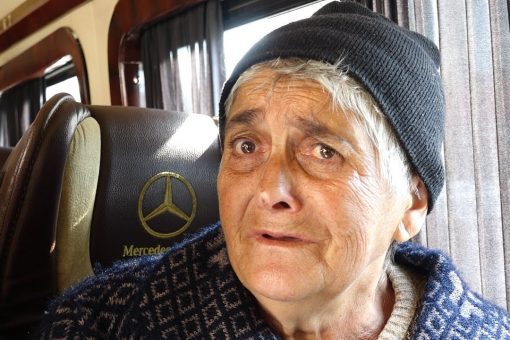
A day on patrol is a blend of meticulous observation and deeply human interaction. The primary concern voiced by villagers is often not the military threat, but the struggle for a basic necessity: water.
In the village of Sotk, residents explain that a lack of rain has dried up sources, and the village is divided—one part gets water 24/7, the other for just two hours a day. In Norabak, an 88-year-old man says the wells in the mountains can no longer be maintained. While these issues are pressing, the sense of security is the constant, underlying current.
“Your presence somehow brings stability and peace”, – one elderly man tells Kouri and his translator, after recounting how his village was destroyed in 1991. In the town of Vardenis, a shopkeeper with a resilient smile is emphatic. “We are not afraid of anything”, – she says. “We see our soldiers in their positions. We are with them. We feel safe.”
This feedback is what the monitors carry with them. “Those are the most rewarding moments”, – Kouri admits. “When we really learn that the work we have done is meaningful.”
The monitors see signs of hope in the quiet resilience of the communities. “It’s very positive”, – Kouri remarks, pointing to a newly built house. “Somehow I feel that if people are ready to invest, to build new houses, there is a kind of hope that the situation will be solved and peace would come.”
“The sum of many good things can change something”
The EU monitors find their own ways to decompress. For Mika, it’s running in the forests near Martuni, a “counterbalance” to the stress of the job. For Swantje, it’s yoga, sports, and a garden project.
In a small garden plot at the FOB, sunflowers and other plants grow, planted by Swantje and her colleague. “We planted some flowers from a local shop. I wasn’t so enthusiastic in the beginning, but it turned out to be very beautiful, so we are actually very proud of our garden”, – says Swantje.
uploads.knightlab.com
Swantje Meinke has a strong background in the German police. Since graduating in 2014, she has worked in various roles, including as part of a first-responder (Crime Scene Investigation) CSI unit and an investigation group that dealt with right-wing terrorism. Her police work in Germany preceded a mission in Afghanistan, an experience she found deeply meaningful.
Swantje has been with the mission since October 1st of last year.
“In general, because of my experience in Afghanistan, I would say that I’m more thankful”, – says Swantje. “The security situation there was really intense. My local assistant, a woman, told me that when she says goodbye to her family in the morning, they say goodbye as if they will never meet again because they never know if they will die during the day from all the attacks in Kabul.”
She finds Armenian society to be different from that in Afghanistan, but also different from her native Germany.
“Normally, you see more men on the streets, but I’ve also met a lot of very strong women here; it’s not like they are pushed down or anything. My impression is that they are more modest; they tend to take a step back and maybe let the men lead conversations. I’m always very happy when I meet women here, especially when they are alone, because then they are even more open and talk more than if they were with a man.”
Through her work abroad, Swantje learned that a single person cannot save the world. She says that sometimes a small contribution doesn’t save the world, but it can mean the world to an individual.
“I think that’s one thing you should know. In the end, it’s not my single contribution that will change everything, but I think it’s the sum of many good things that might have a chance to change something”, – she explains. “Therefore, what I’m doing here is just a tiny piece. We are just one piece of the puzzle. We are all trying to complete the peace puzzle in the end. This is what I mean by that.”

The mission family
Far from home, the team of FOB Martuni has become a “mission family,” as Mika calls it. Kouri, as the team leader, sees maintaining morale as a core part of his job. “I believe that if the people feel well-treated, they are then motivated, and motivation leads to commitment to the work”, – he says. They organize “pancake Thursdays” or cook for each other to build a social environment.
Staying connected to family is crucial. Kouri, a husband and father of three grown children, says the work would be impossible without their full support. He speaks with them daily and has even brought them to Armenia to travel the country with him. “They are really willing and keen to also learn about Armenian culture”, – he says with a smile.
As the patrol day ends and the monitors prepare their confidential reports for Brussels, the mission’s purpose crystallizes. It exists in the space between high-stakes geopolitics and the daily life of a farmer worried about his water supply. It is measured not in military victories, but in the quiet confidence of a shopkeeper and the hope symbolized by a new house on a contested border.
It is, as Swantje Meinke would say, a blink of peace in a world that desperately needs it.
Understanding the EU’s Civilian and Military Operations
The European Union’s foreign policy missions are carried out by the European External Action Service (EEAS), the EU’s diplomatic service established in 2011. The primary goal is to promote peace, security, and European interests globally, operating on the principle that Europe’s security begins abroad.
The main instrument for these efforts is the Common Security and Defence Policy (CSDP), which deploys both civilian and military missions to manage crises. Since 2003, the EU has launched over 40 such operations across Europe, Africa, and Asia. Currently, there are 21 ongoing CSDP missions involving approximately 4,000 personnel detached by EU Member States.
These missions are broadly categorized as civilian or military:
Civilian Missions, like the EU Mission in Armenia (EUMA) (EUMA’s mandate doesn’t focus on security sector reform or rule of law), focus on observing and reporting on the situation on the ground, contributing to human security in conflict-affected areas and supporting the confidence building between Armenia and Azerbaijan.
Military Missions are involved in training, military assistance, and peacekeeping operations, such as EUFOR ALTHEA in Bosnia-Herzegovina.
The deployment and management of these missions are a coordinated effort. Decisions are made by EU countries through the Foreign Affairs Council. Personnel are provided by Member States, and operational command is handled by dedicated headquarters for civilian ( CivOpsHQ ) and military (MPCC) missions.
Gevorg Tosunyan
This article was published within the framework of the “Explaining Democracy: Reporting Initiative” program, with the support of the Embassy of the Kingdom of the Netherlands in Armenia.