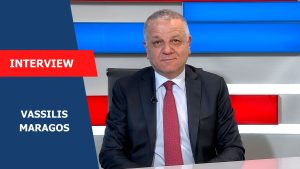
The Interview of the Foreign Minister of Armenia Ara Aivazian “Al Arabiya” news agency.
Question: Now from Abu Dhabi via ZOOM we connect with His Excellency Ara Aivazian, Foreign Minister of Armenia. Welcome to the program. First, what are the reasons for President Sargsyan to decline the signing of the decree?
Ara Aivazian: Well, thank you, indeed, it is a pleasure to be with you. Of course, you know that we have a very complicated situation in the aftermath of the aggression unleashed by Azerbaijan against Nagorno-Karabakh. The situation also had its repercussions on the internal situation in Armenia. Of course, we are now confronting internal difficulties, but I would like to emphasize the fact that Armenia is a democracy, may not a perfect one. And recent years we witnessed significant achievements in this regard. This is the path of development that we have chosen and we are not going to backtrack from this path. As for the internal processes within Armenia, this is going on strictly upon the provisions of the Constitution. And it’s my conviction that the current difficulties can be overcome through dialogue, consolidation, and unification of our society both in Armenia and Artsakh (Nagorno-Karabakh) to safeguard and protect our state and national interests.
Question: Mr. Ayvazian, you said the situation around Nagorno-Karabakh was the cause of the political crisis in Armenia and the attempted coup.
Ara Aivazian: Of course, the results of the aggression unleashed by Azerbaijan had its negative impact on internal stability in Armenia but I strongly disagree with the qualification of the attempted coup d’etat in Armenia.
Question: This is not an attempted coup, so what is it, Minister?
Ara Aivazian: This was a kind of political positioning of some members of General Stuff. They just made a political statement, which is not an attempted coup itself. This was also the assessment of different countries and international organizations. There are no elements of a coup d’etat in Armenia. And Armenia continues to be a democracy and the current situation, as I said, will be dealt according to democratic standards in our society.
Question: Minister, Armenia said, that without Turkey’s support to Azerbaijan, Azerbaijan would not have achieved military victory against Armenia. What is your assessment of Turkey’s involvement in the crisis?
Ara Aivazian: Well, it’s not a secret that Turkey played and continues to play an extremely destabilizing role in our region. That role was vividly exposed during the recent 44-day aggression unleashed by Azerbaijan. That country not only merely supported Azerbaijan but was strictly involved in all military actions and phases of this aggression started from planning to ground operations. I’d like to recall that Turkey together with Azerbaijan on the threshold of the war conducted a large-scale military drill with the involvement of the Turkish air force. That country resorted to the non-usual toolkit: export of foreign terrorist fighters to our region for its power projection.
The involvement of Turkish-affiliated foreign terrorist fighters in the war is a well-known fact that was confirmed by international media, world leaders, and many international bodies, such as the UN Working Group on Mercenaries. And it is also verified by captured terrorists who revealed the chain from recruitment to their transfer to the region.
A hundred and six years have passed since the Armenian Genocide, yet Turkey continues to spearhead new atrocities against Armenia now in our region.
Yet the South Caucasus is not the only target of Turkey. The world has continuously witnessed the destabilizing role of Turkey in the Middle East, in the Eastern Mediterranean, and now in the South Caucasus. Impunity inspires and entails new crimes, and these words are fully describing the attitude and stance of Turkey towards its neighbors.
Question: Minister, you spoke about Turkey’s role in the crisis in Nagorno-Karabakh. And you said Turkey provided fighters in the conflict. Is this role of Turkey still going on?
Ara Aivazian: Well, both Azerbaijan and Turkey are now claiming that conflict is solved. And by saying this they tried to validate the use of force as an effective means, legitimate means to solve the conflicts. I would like to stress that this is a very dangerous precedent for conflict resolutions in international relations. Now we are hearing confusing messages from official Ankara. And I would like to say that based on the common past with Turkey, it’s high time not to be guided by the messages but real actions. And I believe that the international community should play a conducive role that Turkey changes its aggressive attitude towards Armenia.
Regarding foreign terrorist fighters and mercenaries, which were exported, transferred to our region, I think this is an issue of regional and international security, and that issue should be solved by an unequivocal stance of the international community. The terrorist fighters and mercenaries should be pulled out from our region.
Question: Minister, does Armenia consider that the international community is working hard to find a solution for the Nagorno-Karabakh crisis?
Ara Aivazian: First and foremost, Armenia does not consider that the aggression unleashed by Azerbaijan creates the basis for the solution of the conflict, nor an opportunity for regional cooperation. Armenia stands ready for the resumption of the peace process, under the auspices of the OSCE Minsk Group Co-Chairs, and they are Russia, the US, and France. We have to address the core pending issues, which are not addressed in the statement of November 9, signed by the leaders of Armenia, Azerbaijan, and Russia. I would like to remind that the essence of the Nagorno-Karabakh conflict is not a territorial dispute; it is about the survival of the autochthonous population of Artsakh of Armenian origin, which lived there for thousands of years; it is about their rightful self-determination, their right to master their own destiny. So, we have to address the right of those people to self-determination, which entails also the issue of the status of Nagorno-Karabakh. It should be very clear for Azerbaijan and Turkey that the current status quo, which occurred after the aggression and the illegal use of force can neither be stable, nor acceptable for ensuring lasting peace, security, and stability in the region.